






Walking down the grocery store aisle feels like navigating a minefield. Bright packaging proclaims products are “all-natural,” “low-fat,” or “heart-healthy.” But the truth isn’t on the front of the box—it is hidden on the back. If you have been struggling to drop body fat, manage your energy, or maintain a clean diet despite buying “healthy” foods, you aren’t failing your diet. The food industry is tricking you.
The key to reclaiming your health and taking complete control of your fitness goals lies in mastering the nutrition label. This isn’t just a list of numbers; it is your ultimate shield against deceptive marketing.
This comprehensive guide breaks down how to read a nutrition facts panel like a professional, expose hidden ingredients, and optimize your grocery shopping for sustainable health and physical longevity.
1. The Anatomy of a Nutrition Label: Decoding the Grid
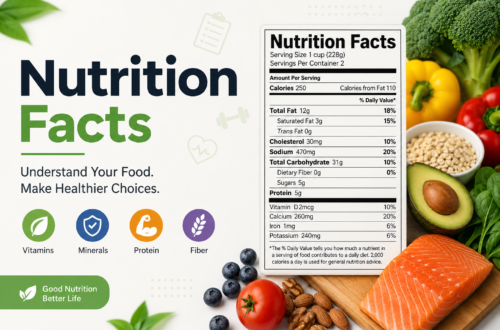
To beat the food manufacturers at their own game, you must understand exactly how to read a nutrition label from top to bottom. The panel is highly regulated, but companies use specific visual and mathematical tricks to manipulate your perception of how healthy a food item truly is.
The Serving Size Deception
The absolute first thing your eyes must look at is the Serving Size and Servings Per Container. Food brands frequently use an incredibly small serving size to make the total calories, fat, and sugar look deceptively low.
For example, a standard bottle of iced tea or a single bag of chips might look like a single-serving snack. However, checking the label often reveals the container actually holds 2.5 or 3 servings. If you consume the whole package, you have to multiply every single number on that label by three. Always calculate the total package volume before tracking your macros.
The Percent Daily Value ($\%DV$) Shortcut
On the right-hand side of every nutrition panel, you will see the Percent Daily Value ($\%DV$). These percentages are based on a standard 2,000-calorie daily intake, which may or may not match your personal metabolic rate. However, the $\%DV$ is incredibly useful as a quick screening tool:
-
5% DV or less means the food is low in that specific nutrient.
-
20% DV or more means the food is high in that specific nutrient.
As a general rule for optimized health, you want to look for foods that have a low percentage for saturated fat, sodium, and added sugars, while prioritizing a high percentage for dietary fiber, vitamin D, calcium, iron, and potassium.
2. Unmasking the Big Three: Macronutrient Optimization
Once you check the serving size, your focus should shift to the macronutrient breakdown. Understanding how to analyze these numbers determines your success with muscle development and fat loss.
[Total Calories] ➔ Fuel Source
   ├── [Total Fat] ➔ Saturated vs. Trans Fats (Avoid Trans!)
   ├── [Total Carbohydrates] ➔ Dietary Fiber vs. Total Sugars
   └── [Protein] ➔ Lean Muscle Preservation & Satiety
Total Fat vs. Bad Fats
Fat is a crucial nutrient for hormone production and joint health, but the type of fat matters immensely. Look past the “Total Fat” number and look directly underneath it:
-
Saturated Fat: Keep this balanced. High amounts of low-quality saturated fats from ultra-processed items can impact cardiovascular health.
-
Trans Fat: This number should strictly be 0 grams. Trans fats raise systemic inflammation and harm cholesterol levels. Be careful: federal laws allow brands to print “0g Trans Fat” if a serving contains less than 0.5 grams. Check the ingredient list for hydrogenated or partially hydrogenated oils—if those words are there, trans fat is present.
The Carbohydrate Breakdown: Fiber vs. Sugar
Carbohydrates are your body’s preferred source of training energy, but the quality varies wildly. When reviewing total carbohydrates, subtract the Dietary Fiber from the total amount. Fiber regulates blood sugar, improves gut microbiome health, and keeps you full for hours.
Directly below fiber, look at Total Sugars and Includes [X]g Added Sugars. Natural sugars found in fruit and dairy come packed with vitamins and fiber. Added sugars, however, are empty calories injected into processed foods to make them highly palatable. Keep your daily added sugar intake as close to zero as possible to avoid rapid insulin spikes and energy crashes.
The Protein Quotient
Protein is the building block of lean muscle tissue and the most satiating macronutrient. When analyzing a nutrition label, look for a high protein-to-calorie ratio. If a food item has 200 calories but only provides 2 grams of protein, it is primarily a carbohydrate or fat fuel source, not a muscle-building food.
3. The Ingredient List: Where the Truth is Hidden
If the nutrition facts panel is the summary, the Ingredient List is the full detective report. Food components are listed in descending order by weight. The ingredients used in the largest amounts are listed first, followed by smaller quantities.
If the first three ingredients listed include sugar, refined flour, or hydrogenated oils, put the item back on the shelf. It is a highly processed food masquerading as a health product.
The Hidden Names for Sugar
Food manufacturers know that consumers look for the word “sugar.” To bypass this, they break sugar down into multiple different chemical variations so that no single form weighs enough to sit at the front of the ingredient list. Look out for these common aliases for hidden sugar:
-
High-fructose corn syrup ($HFCS$)
-
Crystalline fructose or dextrose
-
Evaporated cane juice
-
Maltodextrin
-
Agave nectar, honey, or maple syrup
-
Barley malt or brown rice syrup
If you see four or five of these terms scattered across an ingredient list, the product is essentially a candy bar in disguise, regardless of what the front package claims.
4. Deceptive Marketing Phrases Exposed
The front of food packaging is covered in psychological hooks designed to bypass your logical thinking. Here is what those popular marketing phrases actually mean under regulatory guidelines:
-
“Light” or “Lite”: This simply means the product has 50% less fat or one-third fewer calories than the brand’s regular version. To make up for the lost flavor from removing fat, companies routinely dump massive amounts of added sugar and sodium into “light” products.
-
“Low-Fat” vs. “Fat-Free”: Low-fat requires an item to have 3 grams of fat or less per serving, while fat-free requires less than 0.5 grams. Just like “light” items, these are almost always chemical science experiments loaded with artificial thickeners and sugars to mimic the mouthfeel of real fat.
-
“Made with Whole Grains”: This phrase is highly misleading. A product can contain 99% refined white flour and only 1% whole wheat, and it can legally bear this label. Look for the stamp “100% Whole Grain” or ensure a whole grain is explicitly listed as the absolute first ingredient.
5. Summary Checklist for Smart Shopping
To make reading nutrition labels effortless during your next grocery trip, keep this simple four-step workflow in mind:
| Step | Action Item | Target Objective |
| 1 | Check Serving Size | Multiply the values if you plan to eat the entire package. |
| 2 | Inspect the Calories | Ensure the caloric density aligns with your active energy needs. |
| 3 | Evaluate the “Bad Three” | Scan for high saturated fats, hidden trans fats, and added sugars. |
| 4 | Verify Ingredients | Reject products with long lists of artificial chemicals and hidden sugars. |
Frequently Asked Questions (FAQs)
1. Why do some foods say “0g Trans Fat” but still contain hydrogenated oil?
Food labeling laws allow manufacturers to round down to zero if a product contains less than 0.5 grams of trans fat per serving. If you eat multiple servings of that food, you can easily consume a dangerous amount of synthetic trans fats. Always audit the ingredient list for the words “partially hydrogenated” to find the truth.
2. What is the difference between total carbohydrates and net carbs?
“Net carbs” is a marketing concept rather than a formal regulatory term on the nutrition label. Net carbs are calculated by subtracting dietary fiber and sugar alcohols from the total carbohydrate count, under the principle that fiber and sugar alcohols have a minimal impact on blood glucose levels.
3. How do I identify hidden sugars if the label says “0g Sugar”?
Look closely at both the “Added Sugars” line on the panel and the ingredient list. Companies often use sugar alcohols (like erythritol or xylitol) or artificial syrups (like maltodextrin) to sweeten foods without triggering the official “Total Sugars” metric on the grid.
4. Does a high percent daily value ($\%DV$) mean a food is automatically healthy?
Not necessarily. A high $\%DV$ is excellent when it applies to essential micronutrients like calcium, iron, potassium, or dietary fiber. However, if a food has a high $\%DV$ for sodium, saturated fat, or added sugar, it can easily derail a clean nutrition strategy if eaten regularly.
5. Why is the ingredient list sometimes more important than the calorie count?
Calories tell you the quantity of energy a food provides, but the ingredient list tells you the quality of that energy. A 200-calorie snack made of whole almonds provides sustained energy, healthy fats, and cellular nutrition, whereas a 200-calorie snack made of refined flour and corn syrup triggers fat storage and subsequent energy crashes.
Back-End Metadata Assets
High-CTR Click Title
The Nutrition Label Lie: How Food Companies Are Secretly Sabotaging Your Diet