
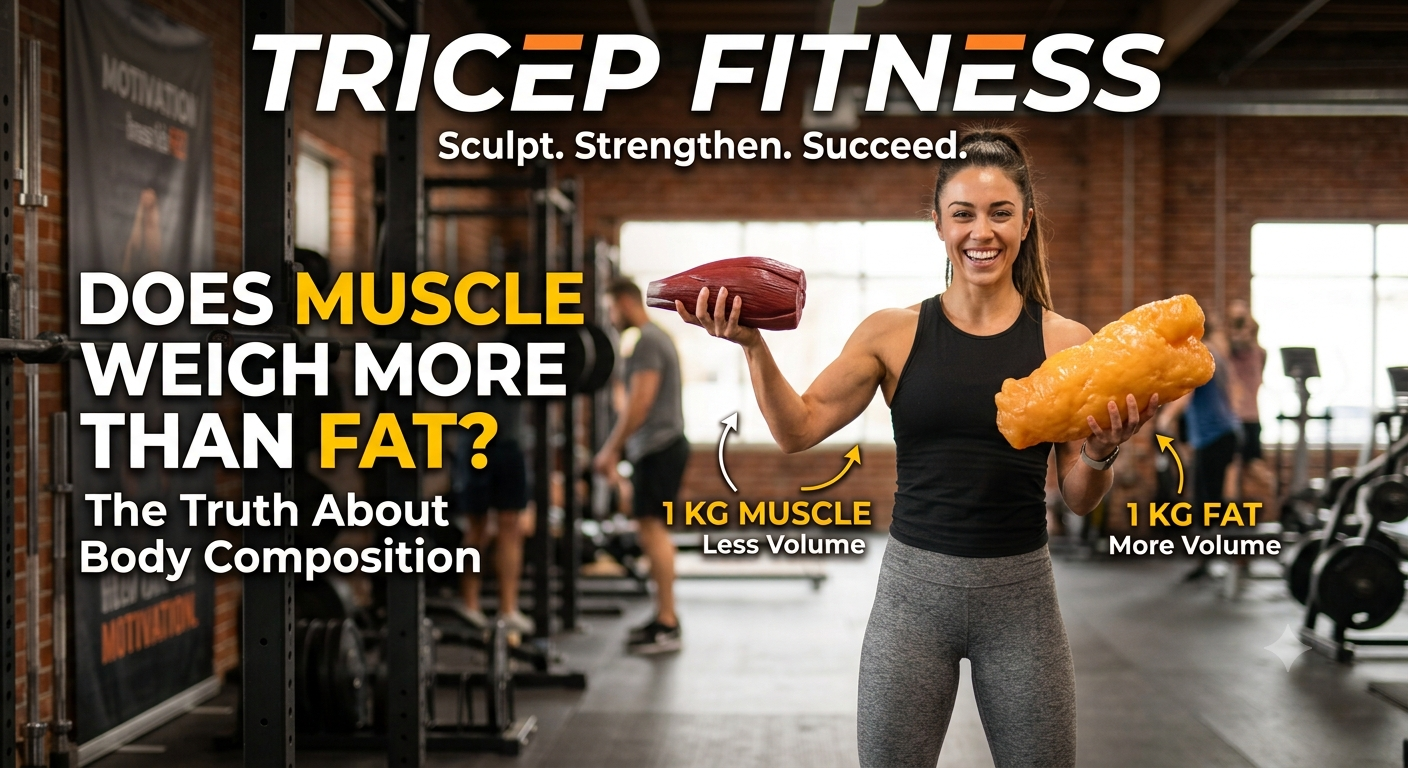
Does Muscle Weigh More Than Fat? The Science of Body Composition Explained
It is one of the most common frustrating scenarios in fitness: you have been working out consistently for weeks, eating clean, staying hydrated, and pushing through tough workouts. You step onto the scale expecting to see a lower number, but the needle hasn’t budged—or worse, it went up.
Before you get discouraged and abandon your routine, there is a fundamental rule of human biology you need to understand: a pound of muscle weighs exactly the same as a pound of fat.
However, the physical space they occupy in your body, their impact on your health, and how they shape your physique are drastically different.
Understanding the relationship between muscle density, fat volume, and body composition is the single most important step in taking control of your health journey. Here is everything you need to know about the science of muscle versus fat, why the scale often lies, and how to measure real progress.
The Physics of Body Weight: Density vs. Mass
To clear up the confusion, we must look at basic physics. A pound of muscle weighs $1\text{ lb}$ ($0.45\text{ kg}$), and a pound of fat weighs $1\text{ lb}$ ($0.45\text{ kg}$). Mass is mass.
The difference lies in density.
-
Muscle is dense and compact: Muscle tissue is tightly packed with protein fibers, water, and glycogen. Because of its structural density, muscle takes up about 18% less volume than fat of equal weight.
-
Fat is bulky and less dense: Fat tissue (adipose tissue) consists of lipid droplets storing energy. It is far more spread out and takes up significantly more physical space on your body frame.
Think of it like comparing a pound of lead to a pound of feathers. Both weigh identical amounts on a balance scale, but a pound of feathers fills a massive pillowcase, whereas a pound of lead fits in the palm of your hand.
When you gain 5 pounds of muscle while losing 5 pounds of fat, your total weight remains unchanged on the scale. However, your waistline shrinks, your clothes fit looser, and your body looks noticeably leaner and firmer.
What Is Recomposition? Gaining Muscle While Losing Fat
The biological process of building lean muscle mass while simultaneously shedding body fat is known as body recomposition.
When beginners start weight training or return to exercise after a long break, body recomposition happens rapidly. Your body adapts to progressive resistance training by expanding muscle fibers, while a clean diet forces your body to burn stored adipose tissue for fuel.
During body recomposition, traditional bathroom scales fail to give an accurate picture. The scale measures total body mass—which includes water, skeletal weight, organs, muscle, fat, and undigested food. It cannot distinguish between 5 pounds of dense, metabolic muscle tissue and 5 pounds of excess body fat.
If you rely solely on body weight to measure your fitness success, you risk throwing away real physical progress simply because your scale stays static.
The Metabolic Advantage of Muscle Tissue
Beyond physical appearance, the major distinction between muscle and fat comes down to metabolic activity.
Muscle is active tissue that constantly consumes energy to maintain, repair, and function. Fat tissue, on the other hand, is primarily energy storage with a much lower metabolic demand.
Resting Metabolic Rate (RMR)
Your Resting Metabolic Rate represents the calories your body burns at total rest just to keep vital functions—like heart rate, breathing, and cell restoration—operating smoothly.
-
1 pound of muscle burns roughly 6 calories per day at complete rest.
-
1 pound of fat burns only 2 calories per day at complete rest.
While burning 6 calories per pound of muscle might seem modest at first glance, the cumulative effect over time is substantial. A person carrying 15 additional pounds of lean muscle tissue will naturally burn significantly more calories daily than someone of the same total weight carrying higher body fat levels—even while sleeping.
Furthermore, muscle tissue acts as a storage reservoir for glucose (blood sugar). Having more lean muscle improves insulin sensitivity, ensuring that carbohydrates from your diet are prioritized for powering your muscles rather than being converted into stored body fat.
Health Implications: Visceral Fat vs. Subcutaneous Fat
Not all fat in the human body operates the same way. When assessing health risks, the location of fat matters far more than total body weight.
Body fat falls primarily into two distinct categories:
-
Subcutaneous Fat: This is the fat located directly under your skin. It is the pinchable fat around your arms, thighs, and hips. While excess subcutaneous fat affects body shape, it poses less immediate danger to internal organs.
-
Visceral Fat: This is deep-seated fat stored around your internal organs within your abdominal cavity (liver, pancreas, kidneys). High levels of visceral fat are strongly linked to chronic health conditions, including Type 2 diabetes, cardiovascular disease, systemic inflammation, and metabolic syndrome.
Building lean muscle tissue actively helps combat visceral fat accumulation. Resistance exercise improves metabolic efficiency and hormones like human growth hormone (HGH) and testosterone, promoting fat breakdown deep inside the abdominal area.
Why the Scale Fluctuates (And Why You Should Ignore It)
If you are frustrated by daily weight spikes while exercising, several biological factors cause standard bathroom scales to fluctuate unpredictably:
1. Exercise-Induced Water Retention
When you perform strength training exercises, you create micro-tears in your muscle fibers. This is a healthy process that signals the body to rebuild stronger tissues. However, to repair this damage, your body initiates a localized inflammatory response, holding onto extra water in the muscles to aid recovery. This temporary fluid retention can cause the scale to jump 2 to 5 pounds overnight.
2. Glycogen Storage
When you train, your body stores excess carbohydrates in your muscles as glycogen to fuel future workouts. Every single gram of glycogen stored in muscle tissue binds to approximately 3 to 4 grams of water. As your muscles adapt to fitness by storing more energy, your overall weight may temporarily increase.
3. Hormonal Shifts and Sodium Intakes
Changes in dietary sodium intake, stress levels (cortisol), and natural monthly hormonal cycles cause significant fluid balance changes that have nothing to do with fat gain.
Better Ways to Measure Your Fitness Progress
Since standard bodyweight scales provide an incomplete picture, tracking your body composition requires more precise methods.
1. Progress Photographs
Take full-body photographs under consistent lighting every 2 to 4 weeks. Visual changes in muscle definition and body symmetry often show dramatic improvements long before the scale reflects them.
2. Body Measurements
Use a simple vinyl measuring tape to track the circumference of key body regions once a month:
-
Waist (at the belly button)
-
Hips (at the widest point)
-
Chest
-
Thighs and Biceps
If your waist measurement shrinks while your weight remains unchanged, you are successfully burning fat and building muscle.
3. Clothes Fit
How your jeans, shirts, and waistbands feel is often the most reliable daily indicator. Gaining lean muscle and dropping body fat will make your clothes feel roomier around the waist and hips.
4. Advanced Body Composition Scans
For accurate numbers on fat mass versus muscle mass, consider advanced tracking tools:
-
DEXA Scan (Dual-Energy X-Ray Absorptiometry): The gold standard in medical imaging to measure bone density, body fat percentage, and precise muscle mass layout.
-
Bioelectrical Impedance Analysis (BIA): Available on smart scales and handheld devices, these run a low-level electrical current through the body to estimate fluid, fat, and lean mass levels.
-
Skinfold Calipers: Used by fitness professionals to measure subcutaneous fat thickness at specific body sites.
How to Optimize Your Body Composition
To maximize lean muscle growth while shedding excess fat, focus your weekly routine on these three foundational pillars:
                  ┌──────────────────────────────┐
                  │   Progressive Resistance     │
                  │   Training (3-5x/week)       │
                  └──────────────┬───────────────┘
                                 │
                                 ▼
┌──────────────────────────────┐   ┌──────────────────────────────┐
│    High-Protein Nutrition    │───│    Sufficient Sleep &        │
│    & Controlled Calories     │   │    Recovery Protocols        │
└──────────────────────────────┘   └──────────────────────────────┘
-
Prioritize Progressive Resistance Training: Lift weights, use resistance bands, or perform challenging bodyweight exercises 3 to 5 times per week. Focus on compound movements like squats, deadlifts, chest presses, and pull-ups to recruit the greatest amount of muscle tissue.
-
Eat Adequate Protein: Protein supplies the amino acids necessary to rebuild muscle tissue. Aim for roughly 0.7 to 1.0 grams of protein per pound of target body weight daily. High-quality sources include chicken breast, eggs, lean beef, fish, tofu, legumes, and whey protein.
-
Maintain a Modest Caloric Strategy: To lose body fat without burning through muscle tissue, aim for a slight caloric deficit (around 300 to 500 calories below maintenance per day). Severe starvation diets strip away valuable muscle tissue, slowing down your long-term metabolic health.
Frequently Asked Questions (FAQs)
1. Does muscle really weigh more than fat?
No. One pound of muscle weighs exactly the same as one pound of fat. However, muscle is significantly denser than fat, meaning one pound of muscle occupies less physical volume than one pound of fat.
2. Can you gain muscle and lose fat at the same time?
Yes. This process is called body recomposition. It happens most effectively in beginners, individuals returning to training after a break, or those carrying higher body fat levels who follow a structured resistance training program paired with adequate protein intake.
3. Why am I gaining weight when I start working out?
Initial weight gain after starting a new exercise routine is usually due to temporary water retention. When you work out, muscle tissue undergoes temporary micro-tears and retains extra fluid to repair and rebuild itself.
4. How much space does fat take up compared to muscle?
By volume, muscle tissue is roughly 18% denser than adipose (fat) tissue. This means 5 pounds of fat will take up noticeably more space on your frame than 5 pounds of muscle tissue.
5. Should I stop using a bathroom scale to track weight loss?
You don’t need to eliminate the scale entirely, but you should not rely on it as your sole progress indicator. Combine scale measurements with progress photos, waist measurements, and how your clothes fit to get an accurate view of your progress.
6. Does having more muscle speed up your metabolism?
Yes. Muscle tissue is metabolically active and consumes around 6 calories per pound per day at rest, compared to fat tissue, which consumes only about 2 calories per pound per day.